

Advanced Regenerative Medicine
Advanced Regenerative Medicine
- The Goswami Clinic
Stem Cell Therapy for Joints: What It Can and Can’t Treat
Medically reviewed by Dr. Gaurav Goswami, MD — prepared October 2026
Stem cell therapy for joints has been studied most in knee osteoarthritis, where the best evidence suggests a small average improvement in pain and function, with more limited research for the hip and shoulder. It is generally considered for mild-to-moderate joint degeneration and certain tendon problems. It cannot rebuild a severely worn joint, correct major structural or alignment problems, or replace the medical treatment that inflammatory conditions like rheumatoid arthritis require.
Contact Us
Which Joints Have the Most Research Behind Them?
The knee is by far the most studied joint. The 2025 Cochrane review of stem cell injections for knee osteoarthritis included 25 randomized trials and found, based on low-certainty evidence, a small improvement in pain and function compared with placebo injections. A systematic review focused on early-to-moderate knee osteoarthritis reached a more favorable conclusion for single injections in Kellgren-Lawrence grade I to III arthritis, while noting wide variation between studies.
Research on other joints is thinner. A systematic review of stem cell injections for hip osteoarthritis found promising results for pain and function but emphasized that high-quality studies are limited. In the shoulder, much of the strongest research involves stem cells added during surgical rotator cuff repair rather than injection alone. If you’re considering treatment for a joint other than the knee, ask your physician what evidence exists for that joint specifically.
Contact Us
What Conditions Is Stem Cell Therapy Typically Considered For?
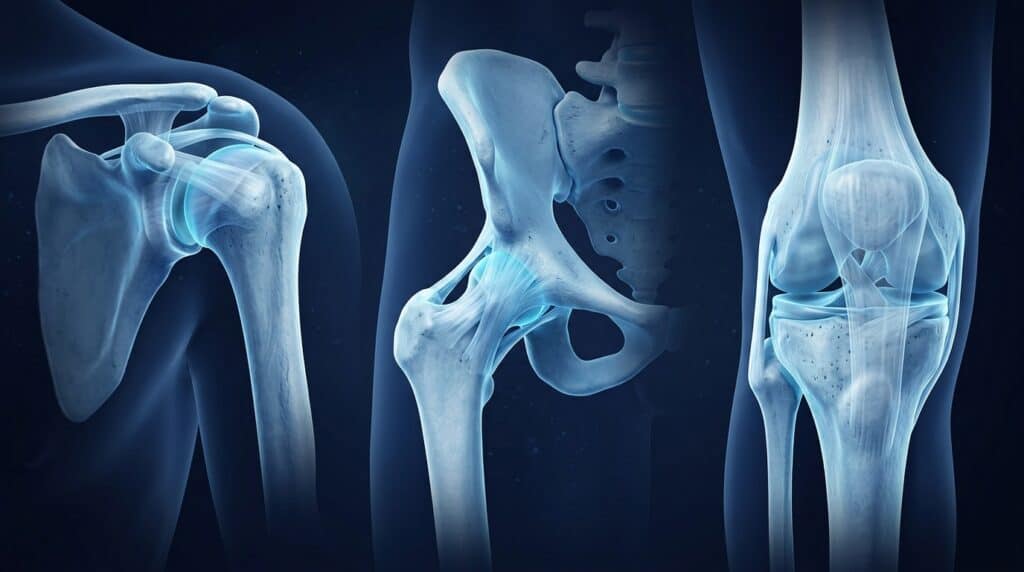
In orthopedic practice, stem cell joint injections are most often considered for mild-to-moderate osteoarthritis, cartilage wear, and certain tendon and ligament problems that haven’t responded to conservative care. Common areas include the knee, hip, and shoulder.
The goal is usually practical: less pain during daily activities, better function, and in some cases more time before surgery becomes necessary. Treatment is typically one part of a broader plan that may also include strengthening, activity changes, and other therapies.
How Do Arthritis Grades Affect Candidacy?
Physicians often describe knee arthritis using the Kellgren-Lawrence scale, which grades X-ray changes from 0 (no arthritis) to 4 (severe arthritis with marked narrowing of the joint space). Most stem cell studies have focused on grades I through III, and severe grade IV arthritis is often excluded from clinical trials.
That pattern matters for expectations. In mild-to-moderate arthritis, meaningful cartilage and joint structure remain. In severe, bone-on-bone arthritis, realistic goals are more limited, and joint replacement may be the more reliable option.

What Can’t Stem Cell Therapy Do?
Being clear about limits is part of good care. Stem cell therapy for joints is not expected to:
- Rebuild a severely worn joint. The Cochrane review was uncertain whether stem cell injections affect the structural progression of knee arthritis at all.
- Fix mechanical problems, such as major alignment deformities, an unstable joint, or loose fragments that catch or lock the joint.
- Replace systemic treatment for autoimmune conditions such as rheumatoid arthritis, which are managed with medical care from a rheumatologist.
- Treat an infected joint, which requires urgent medical care.
- Substitute for strengthening. As the National Institute of Arthritis and Musculoskeletal and Skin Diseases explains, joint pain can make people less active, leading to muscle weakness that places more stress on the joint.
How Does Stem Cell Therapy Compare With Other Joint Injections?
Patients often weigh stem cell therapy against cortisone, hyaluronic acid, and PRP injections. Cortisone can calm inflammation quickly but is not designed to repair tissue. Hyaluronic acid injections aim to improve joint lubrication. PRP concentrates platelets from your own blood.
In one randomized trial, bone marrow aspirate concentrate and PRP produced equivalent results for knee osteoarthritis at one year. On the safety side, the 2024 HSS Journal review found that the rate of temporary reactions after stem cell injections (about 12.3%) was in the same range as, or lower than, rates reported for corticosteroid (about 14.3%) and hyaluronic acid (about 27.7%) injections.
Why Does an Accurate Diagnosis Come First?
Joint pain isn’t always coming from the joint. Pain around the hip can originate in the lower back or the sacroiliac joint, knee pain can stem from tendons or the kneecap rather than the main joint surface, and shoulder pain can be referred from the neck. Treating the wrong structure won’t help, no matter how good the treatment is.
That’s why a careful exam and imaging review come before any recommendation. If your pain pattern suggests a source outside the joint, the right treatment may be entirely different, such as care focused on the lower back or SI joint.
How Is Stem Cell Therapy Delivered to a Joint?
In autologous protocols, cells are collected from your own bone marrow, typically from the back of the pelvis, or from a small sample of fat tissue. The sample is processed to concentrate the cells, and the concentrate is injected into the joint or the surrounding tissue.
Image guidance is an important part of delivery. An umbrella review of systematic reviews found ultrasound-guided injections were generally more accurate than injections placed by landmarks alone, especially in the shoulder. Deeper joints such as the hip are often injected under fluoroscopy.
Afterward, temporary soreness and swelling at the injection or collection site are common; in a 2024 review of 48 studies, most such reactions resolved within a week. Improvement, when it occurs, tends to build gradually over weeks to months.
How Do You Know If Your Joint Is a Good Fit?
You may be a reasonable candidate if your imaging shows mild-to-moderate changes, your symptoms haven’t responded to conservative care, you have no active infection, and your goals are realistic. Other options are likely a better fit if your arthritis is severe, your symptoms come from a mechanical or inflammatory problem, or your pain originates outside the joint.
The most reliable way to find out is a physician evaluation that includes an exam and an imaging review. Our article What’s Wrong With My Knee? walks through common sources of knee pain, and our Conditions We Treat page shows the range of problems we evaluate. Bring your imaging reports and a list of treatments you’ve already tried to your consultation.
Frequently Asked Questions
Which joint responds best to stem cell therapy?
The knee has the most research behind it, and most studies focus on mild-to-moderate knee osteoarthritis. Evidence for the hip and shoulder is more limited, so expectations should be set joint by joint.
Can stem cells regrow cartilage?
That hasn’t been established. One meta-analysis reported improvements in cartilage quality but a limited effect on cartilage volume, and the Cochrane review remained uncertain whether stem cell injections change the structure of the knee.
Does stem cell therapy work for bone-on-bone arthritis?
It is generally less likely to help in severe, bone-on-bone arthritis, and many clinical trials exclude it. For end-stage arthritis, joint replacement is often the more reliable option.
Is stem cell therapy for joints FDA-approved?
No. The FDA has not approved any stem cell product for orthopedic conditions such as osteoarthritis, tendonitis, or knee, hip, or shoulder pain. California requires practitioners to provide a specific notice to patients considering these therapies.
Can more than one joint be treated?
Sometimes, depending on your diagnosis, overall health, and treatment plan. Your physician will recommend which areas to treat, and in what order, after an evaluation.
How long does it take to feel a difference after joint treatment?
Improvement, when it occurs, is usually gradual over weeks to months rather than immediate. Your physician will schedule follow-up visits to track your progress.
Wondering whether your joint is a good fit? Schedule a free phone consultation with our team.