



Advanced Regenerative Medicine
Advanced Regenerative Medicine
Hip pain has a way of narrowing your life before you notice it happening. You stop walking the long way around the harbor. You start planning which chair you will sit in. You avoid the stairs at the office. For many patients in Newport Beach and across Orange County, that gradual narrowing continues for years before anyone offers a treatment plan that goes beyond medication and waiting.
At The Goswami Clinic in Newport Beach, CA, we take a different approach to hip pain treatment. Under the direction of Dr. Gaurav Goswami, a triple board-certified physician in surgery, interventional radiology, and regenerative medicine, our clinic focuses on identifying the structures actually generating your pain and then treating them with precision-guided, non-surgical techniques whenever that is appropriate for your condition.
The hip is a ball-and-socket joint built to carry load through an enormous range of motion. That combination of demand and mobility makes it vulnerable in several distinct ways, and the location of your pain often points toward the source.
Osteoarthritis develops as the cartilage lining the femoral head and acetabulum gradually wears down. Patients typically describe deep groin pain, stiffness that is worst in the morning or after sitting, and a slowly shrinking range of motion. Rotating the hip inward often reproduces the discomfort. Hip osteoarthritis is progressive, which is why early evaluation matters.
Pain on the outside of the hip, particularly when lying on that side at night or climbing stairs, frequently points to the greater trochanteric region rather than the joint itself. What was historically called bursitis is now often understood as tendinopathy of the gluteus medius and minimus tendons. This distinction matters because tendon problems and joint problems call for different treatments.
The labrum is a ring of cartilage that deepens the socket and helps stabilize the joint. Tears may produce catching, clicking, or a sharp pinch in the groin during deep flexion. In some patients, an underlying bony shape difference known as femoroacetabular impingement contributes to repeated labral irritation over time.
Not all hip pain comes from the hip. Lumbar nerve irritation and sacroiliac joint dysfunction both refer pain into the buttock and lateral hip, and patients are sometimes treated for months at the wrong structure. Dr. Goswami’s background in interventional radiology and diagnostic imaging is directly relevant here, because distinguishing these sources depends on careful correlation between imaging findings and physical examination.
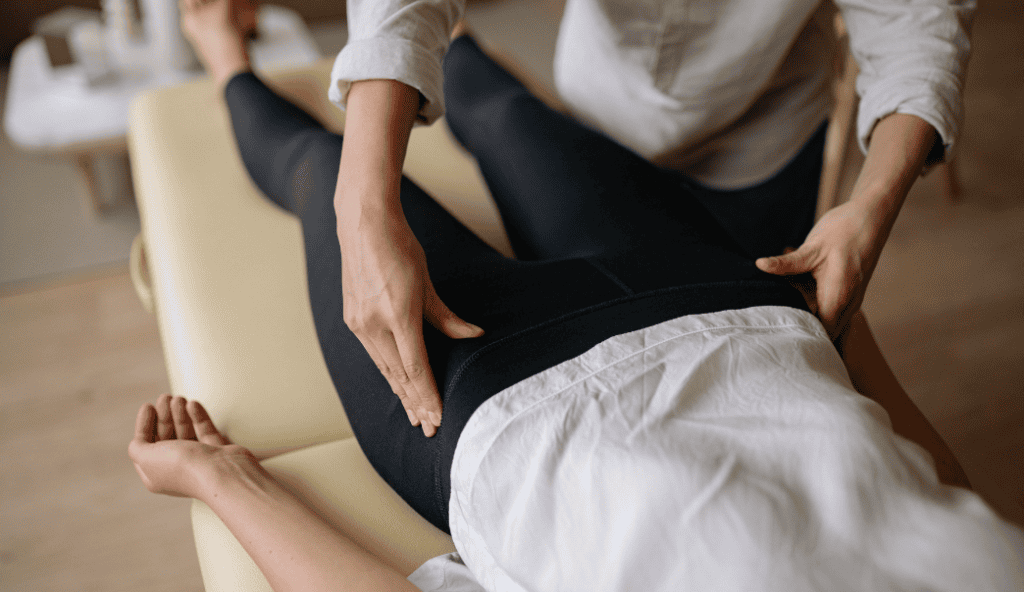
A meaningful hip evaluation at The Goswami Clinic begins with history and physical examination, then moves to imaging review. We look at where the pain sits, what movements provoke it, what relieves it, and how it has changed over time. Prior MRI and X-ray studies are reviewed directly rather than read from a report summary.
This step is not a formality. Two patients can describe hip pain in nearly identical language while having entirely different underlying problems, and a treatment that helps one may do nothing for the other. Identifying the pain generator is the part of the process that determines whether any subsequent treatment has a reasonable chance of helping.
Most patients arrive having already tried some combination of rest, activity modification, anti-inflammatory medication, and physical therapy. These approaches have real value and should not be skipped. Physical therapy in particular can meaningfully improve hip mechanics and reduce load on irritated structures.
When those measures have been exhausted and the remaining options presented are steroid injections or joint replacement, many patients begin looking for something in between. That gap is where regenerative medicine has become a subject of significant patient interest.
PRP therapy uses a concentrated preparation of platelets drawn from your own blood. Platelets contain growth factors involved in tissue signaling and repair. In the hip, PRP is most commonly considered for gluteal tendinopathy and trochanteric pain, where the target is tendon tissue rather than cartilage. Because PRP is derived from your own blood, the risk of allergic reaction is minimal.
Stem cell therapy has become an area of growing research interest for patients with hip osteoarthritis and degenerative joint change. Mesenchymal stem cells are studied for their role in modulating inflammation and supporting the local tissue environment. Research in this area continues to evolve, and outcomes vary between individuals. Stem cell therapy is not appropriate for every patient and is not a guaranteed alternative to surgery.
The hip joint sits deep beneath substantial soft tissue. Unlike the knee, it cannot be reliably accessed by landmark palpation alone. An injection intended for the joint that is delivered into surrounding tissue does not treat the joint, regardless of what was injected.
Dr. Goswami performs image-guided injections using real-time imaging to confirm needle placement before delivery. This is a direct application of his interventional radiology training, and it is one of the clearest distinctions between clinics offering regenerative hip treatment in Orange County.
This is the question most patients actually want answered, and it deserves a direct response rather than a marketing one.
Regenerative therapy is not a guaranteed replacement for hip arthroplasty. For patients with advanced, bone-on-bone arthritis and significant structural collapse, joint replacement remains an appropriate and often excellent operation. What regenerative medicine may offer is an option for patients who are earlier in the disease process, who are not yet surgical candidates, who want to explore conservative approaches first, or who are not good candidates for surgery for other medical reasons.
During your consultation, we will tell you honestly whether we believe you fall into that group. Patients who are better served by an orthopedic surgeon are told so.
Candidacy is determined individually, based on imaging, examination, medical history, and your functional goals. Not everyone who inquires is an appropriate candidate.
Your first step is a free phone consultation with a patient care coordinator, who will gather information about your condition and explain how the evaluation process works. If moving forward makes sense, you will be scheduled for a full consultation with Dr. Goswami that includes examination and imaging review.
Treatments are performed on an outpatient basis using minimally invasive, image-guided technique. Most patients return home the same day. Post-treatment guidance and long-term follow-up are part of the care plan rather than an afterthought.
The Goswami Clinic operates as a cash-pay practice. We do not accept insurance and we do not accept Medicare. This allows us to structure care around clinical judgment rather than coverage determinations, and we state it clearly and early so that patients can make an informed decision about whether our practice is the right fit.
Dr. Gaurav Goswami founded The Goswami Clinic in Newport Beach in 2009. He is triple board certified in Surgery, Interventional Radiology, and Regenerative Medicine, with more than 23 years of post-fellowship clinical experience and over 15 years focused specifically on regenerative medicine. He is the author of The Stem Cell Cure, holds a United States medical device patent, and serves as a Scientific Advisor to the American Society of Regenerative Medicine. Both Dr. Goswami and The Goswami Clinic are certified by the American Board of Regenerative Medicine.
The clinic is located at 4425 Jamboree Road, Suite 120, in Newport Beach, California, and serves patients throughout Orange County including Irvine, Costa Mesa, Huntington Beach, Laguna Beach, and Corona del Mar, as well as patients traveling from elsewhere in the United States and internationally.
There is no single best treatment, because the right approach depends on which structure is generating your pain. Physical therapy, activity modification, and anti-inflammatory measures are typically first. For patients who do not improve, image-guided regenerative options such as PRP or stem cell therapy may be considered. An accurate diagnosis comes first in every case.
Stem cell therapy is being studied for hip osteoarthritis, and some patients report improvement in pain and function. Results vary between individuals, and it is not a guaranteed treatment or a guaranteed alternative to hip replacement. Candidacy depends on the stage of arthritis and your overall clinical picture.
Groin pain that worsens with inward rotation more often suggests the hip joint, while buttock and lateral pain can come from the lumbar spine or sacroiliac joint. The distinction cannot be made reliably from symptoms alone, which is why examination combined with imaging review is necessary.
No. The Goswami Clinic is a cash-pay practice and does not accept insurance or Medicare.
Treatments are minimally invasive and most patients go home the same day. Activity guidance is individualized. Any changes patients notice tend to develop gradually over weeks to months rather than immediately.
The Goswami Clinic is located at 4425 Jamboree Road, Suite 120, Newport Beach, CA 92660, serving Orange County. Call (949) 734-9696.
If hip pain is limiting what you can do and you want to understand your non-surgical options, we invite you to start with a free phone consultation with a patient care coordinator. We will review your situation, explain what is realistic, and tell you honestly whether we think we can help.
THIS NOTICE MUST BE PROVIDED TO YOU UNDER CALIFORNIA LAW. This physician performs one or more stem cell therapies that have not yet been approved by the United States Food and Drug Administration. You are encouraged to consult with your primary care provider before undergoing any stem cell therapy.