



Advanced Regenerative Medicine
Advanced Regenerative Medicine
Sacroiliac joint pain is one of the most frequently missed sources of low back and buttock pain. Patients often spend years being treated for a lumbar disc problem, a hip problem, or generalized back pain before anyone examines the SI joint directly. In the meantime, the pain persists, and confidence in the medical process erodes.
At The Goswami Clinic in Newport Beach, CA, Dr. Gaurav Goswami evaluates and treats sacroiliac joint pain using image-guided, non-surgical techniques. As a triple board-certified physician in surgery, interventional radiology, and regenerative medicine, his approach is built on identifying the pain generator precisely before treating it.
The sacroiliac joints connect the sacrum, the triangular bone at the base of the spine, to the iliac bones of the pelvis. There is one on each side. Unlike the highly mobile joints of the limbs, the SI joints move very little. Their job is load transfer, moving force between the spine and the legs while absorbing shock during walking, running, and lifting.
Because these joints are stabilized by an extensive network of strong ligaments, problems here often involve the ligaments and joint capsule as much as the joint surfaces themselves. That has direct implications for treatment.
Like any joint, the SI joint can degenerate over time. Inflammation of the joint, referred to as sacroiliitis, may develop from degeneration, from inflammatory arthritis conditions, or following injury.
When the supporting ligaments become lax or injured, the joint may move slightly more than it should. That abnormal motion can generate persistent pain and a sensation of instability. Pregnancy, childbirth, and trauma are common contributors.
Patients who have undergone lumbar fusion carry an elevated risk of SI joint pain. When motion is eliminated at fused levels, adjacent structures absorb more load. The SI joint frequently becomes the structure that takes it.
A fall onto the buttock, a motor vehicle collision, or repetitive asymmetric loading in sport or work can all irritate the joint and its ligaments.
Persistent asymmetry in how load moves through the pelvis can, over time, overload one SI joint relative to the other.
SI joint pain has a recognizable pattern, though it is not universal. Patients commonly report:
The distinguishing feature relative to lumbar disc pain is location. SI joint pain typically sits lower and more lateral than discogenic pain, and it usually does not follow a clean nerve root distribution down the leg.
No single test confirms SI joint pain on its own, which is a large part of why it is missed so often.
Evaluation at The Goswami Clinic combines a focused history, provocative physical examination maneuvers that load the joint in specific directions, and review of your existing imaging. Imaging is used as much to rule out other sources, such as disc herniation, stenosis, or hip pathology, as it is to identify SI changes directly.
In some cases, a diagnostic image-guided injection into the joint is used to help confirm the source. If pain meaningfully decreases after an accurately placed injection, that provides useful diagnostic information about where the pain is coming from.
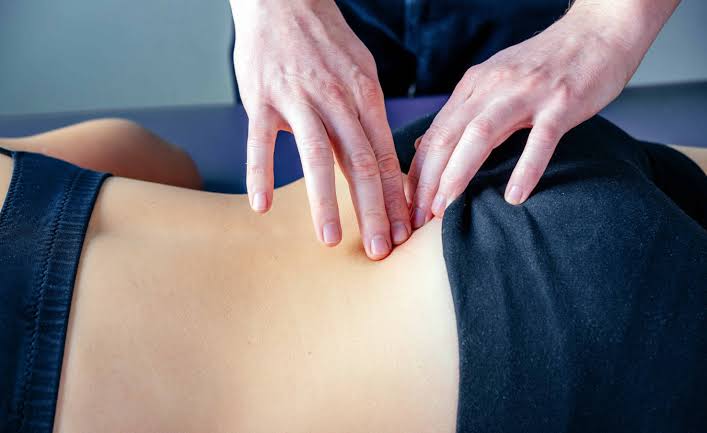
Initial management is conservative and appropriate. Targeted physical therapy addressing pelvic and core stability, activity modification, and anti-inflammatory measures help a meaningful number of patients. Manual therapy and, in selected cases, a pelvic support belt may provide relief.
When these approaches have been given a fair trial without lasting improvement, patients often find the remaining options presented to them are repeated steroid injections, radiofrequency ablation, or SI joint fusion surgery. Many patients want to understand what exists between those points.
Because SI joint pain frequently involves the supporting ligaments and joint capsule rather than cartilage alone, PRP is of particular interest in this joint. PRP uses concentrated platelets from your own blood, which carry growth factors involved in tissue signaling and repair. In the sacroiliac region, PRP may be directed into the joint itself, into the posterior ligamentous structures, or both, depending on examination and imaging findings.
For patients with degenerative change in the joint, stem cell therapy may be considered as part of an individualized plan. Mesenchymal stem cells are studied for their role in modulating inflammation and supporting the local tissue environment. Research continues to develop, results vary between individuals, and this therapy is not appropriate for every patient.
The sacroiliac joint is narrow, irregularly shaped, and oriented differently in every patient. Published work has repeatedly shown that injections attempted without imaging frequently do not enter the joint at all. An injection that misses the target provides neither treatment benefit nor useful diagnostic information.
Dr. Goswami performs SI joint procedures under real-time image guidance, confirming placement before anything is delivered. This is a direct application of his interventional radiology training and is one of the most meaningful differences between providers offering SI joint care in Orange County.
Many patients searching for SI joint pain treatment in Newport Beach encounter primarily chiropractic and manual therapy options. Those approaches have a legitimate role, and some patients do well with them.
What The Goswami Clinic offers is different in kind: a physician-led, image-guided, interventional evaluation performed by a specialist whose training is specifically in accessing structures under imaging. For patients whose SI joint pain has not responded to manual care, that difference is often the reason they come to us.
Candidacy is determined individually. Some patients are better served by other specialists, and we will tell you if we believe that is the case.
Begin with a free phone consultation with a patient care coordinator. If appropriate, you will be scheduled for a full evaluation with Dr. Goswami including examination and imaging review. Procedures are performed on an outpatient basis under image guidance, and most patients return home the same day.
The Goswami Clinic operates as a cash-pay practice. We do not accept insurance and we do not accept Medicare. We state this clearly at the outset so that patients can make an informed decision before investing time in the process.
Dr. Gaurav Goswami founded The Goswami Clinic in Newport Beach in 2009. He is triple board certified in Surgery, Interventional Radiology, and Regenerative Medicine, with more than 23 years of post-fellowship clinical experience and over 15 years dedicated to regenerative medicine. He is the author of The Stem Cell Cure, holds a United States medical device patent, and serves as a Scientific Advisor to the American Society of Regenerative Medicine. Both Dr. Goswami and The Goswami Clinic are certified by the American Board of Regenerative Medicine.
The clinic is located at 4425 Jamboree Road, Suite 120, Newport Beach, California, serving patients across Orange County including Irvine, Costa Mesa, Huntington Beach, Laguna Beach, and Corona del Mar.
SI joint pain usually sits below the belt line over the buttock and often does not follow a clear nerve pattern down the leg, while disc-related pain more commonly radiates in a nerve root distribution. Symptoms alone are not conclusive, which is why provocative examination, imaging review, and sometimes a diagnostic injection are used together.
Yes. Most patients are managed without surgery. Physical therapy, activity modification, and anti-inflammatory measures come first. For patients who do not improve, image-guided options including PRP and, in selected cases, stem cell therapy may be considered.
When lumbar segments are fused, motion that those segments previously absorbed is transferred to adjacent structures. The sacroiliac joint often takes on additional load as a result, which is why SI joint pain is more common in patients who have had fusion surgery.
PRP is being studied for sacroiliac joint pain, particularly where the supporting ligaments are involved. Some patients report improvement in pain and function. Results vary between individuals and PRP is not a guaranteed treatment.
The SI joint is narrow and irregularly shaped, and studies have shown injections attempted without imaging frequently fail to enter the joint. Image guidance confirms placement, which matters both for treatment and for diagnostic accuracy.
No. The Goswami Clinic is a cash-pay practice and does not accept insurance or Medicare.
If you have been told your back pain is nonspecific, or you have been treated for a disc problem without improvement, the sacroiliac joint may be worth evaluating directly. Start with a free phone consultation with a patient care coordinator.
THIS NOTICE MUST BE PROVIDED TO YOU UNDER CALIFORNIA LAW. This physician performs one or more stem cell therapies that have not yet been approved by the United States Food and Drug Administration. You are encouraged to consult with your primary care provider before undergoing any stem cell therapy.