



Advanced Regenerative Medicine
Advanced Regenerative Medicine
Low back pain is the most common musculoskeletal complaint in adults, and it is also one of the most poorly explained. Many patients are told their imaging shows degenerative changes, handed a prescription and a referral to physical therapy, and sent on their way without anyone identifying which structure is actually producing the pain.
At The Goswami Clinic in Newport Beach, CA, low back pain is approached as a diagnostic problem before it is treated as a therapeutic one. Dr. Gaurav Goswami is triple board certified in Surgery, Interventional Radiology, and Regenerative Medicine, and his evaluation focuses on determining which specific structure is generating your symptoms before any treatment is recommended.
The lumbar spine is a stack of load-bearing segments, each containing a disc in front and two facet joints behind, all surrounded by ligaments and muscle and traversed by nerve roots. Pain can come from any of these.
Discs lose hydration and height with age. As they degenerate, the outer annulus can develop fissures that are themselves pain-sensitive. Discogenic pain is often described as a deep, central ache that worsens with sitting, bending forward, and lifting.
Where disc material has actually displaced and is contacting a nerve, the presentation changes and the treatment approach changes with it. That situation is addressed in more detail on our disc injury treatment page.
The paired facet joints at the back of each segment are true synovial joints and they develop arthritis like any other. Facet-mediated pain is typically felt to one or both sides of the midline, worsens with extension and with standing, and often eases when sitting or leaning forward. It frequently coexists with disc degeneration.
Facet arthritis is one form of spinal arthritis, and it is covered alongside other joints on our arthritis treatment page.
Pain that sits below the belt line and over the buttock, rather than in the lumbar spine proper, often originates at the sacroiliac joint. This is one of the most frequently missed sources of chronic back pain, and it is common enough to warrant direct evaluation. See our SI joint pain treatment page for a detailed discussion.
When narrowing of the canal or the nerve root openings develops, the pattern shifts toward leg symptoms that worsen with walking and improve with sitting. Our spinal stenosis treatment page explains that presentation in full.
Soft tissue strain is real and common, and it accounts for a meaningful share of acute low back pain episodes. It also tends to resolve. The patients we see are typically those whose pain has outlasted the timeline that a simple strain would follow.
Pain in the thoracic spine, between the shoulder blades and the lower ribs, is less common than lumbar pain but follows similar principles. The thoracic spine is stabilized by the rib cage, so it moves less and degenerates differently, but the same structures apply: discs, facet joints, and the surrounding soft tissue.
Thoracic pain more often has a postural or muscular component, particularly in patients who spend long hours at a desk. It can also be referred from the cervical spine above or the lumbar spine below. Evaluation follows the same approach: identify the structure, then treat it.
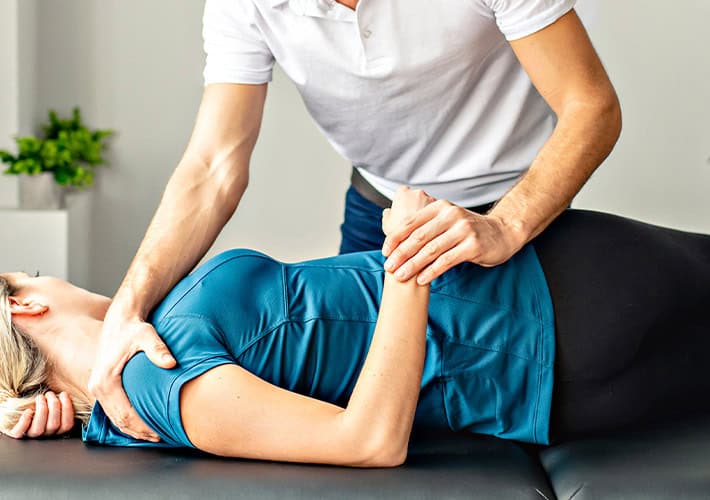
Diagnosis rests on the correlation between three things: what your symptoms actually are, what the physical examination reproduces, and what the imaging shows.
That third element deserves particular attention. Degenerative changes on lumbar MRI are extremely common in adults without back pain, and their presence on a scan does not establish that they are the cause of your symptoms. A report describing disc desiccation and facet hypertrophy describes almost every adult spine past a certain age.
Dr. Goswami reviews imaging personally against the clinical picture rather than working from a radiology report summary. His background in diagnostic and interventional radiology is directly applicable to this step, and it is the part of the evaluation that determines whether any subsequent treatment is aimed at the right target.
Conservative care comes first and should be given a genuine trial. Physical therapy focused on core and hip strength, activity modification, and anti-inflammatory measures resolve or substantially improve a large share of low back pain. Patients who have not done a structured therapy program should generally do one before considering anything else.
The patients who come to us are usually past that point. They have completed therapy, tried medication, and often had one or more steroid injections, and they are being told the remaining options are living with it or considering surgery. Many want to understand what exists in between.
PRP uses a concentrated preparation of platelets from your own blood, which carry growth factors involved in tissue signaling and repair. In the lumbar spine it is most often considered for facet joints and for the posterior ligamentous structures. Because it is autologous, the risk of allergic reaction is minimal. Our PRP therapy page explains the preparation and delivery process in more detail.
For patients with degenerative disc and facet change, stem cell therapy may be considered as part of an individualized plan. Mesenchymal stem cells are studied for their role in modulating inflammation and supporting the local tissue environment. Research continues to evolve and outcomes vary between individuals. Our stem cells for spine page covers the spinal application specifically.
Accuracy matters more in the spine than almost anywhere else. Facet joints are small, disc access requires precision, and the structures involved sit close to nerve roots. Dr. Goswami performs spinal procedures under real-time image guidance with placement confirmed before delivery. An injection that does not reach its intended target provides no benefit regardless of what was in the syringe.
New or progressive leg weakness, loss of bowel or bladder control, or numbness in the groin or inner thighs requires urgent medical evaluation, not a scheduled appointment. Back pain accompanied by fever, unexplained weight loss, or a history of cancer also warrants prompt assessment.
We will say so directly when we believe surgery is the appropriate recommendation. Progressive neurological deficit, significant structural instability, and severe stenosis with a markedly limited walking tolerance are surgical considerations rather than candidates for a trial of regenerative therapy. Patients who need a spine surgeon are told so.
Begin with a free phone consultation with a patient care coordinator. If appropriate, you will be scheduled for a full evaluation with Dr. Goswami including examination and personal imaging review. Procedures are performed on an outpatient basis under image guidance and most patients return home the same day. You can request a consultation here.
The Goswami Clinic operates as a cash-pay practice. We do not accept insurance and we do not accept Medicare. We state this early so patients can make an informed decision before investing further time.
Dr. Gaurav Goswami founded The Goswami Clinic in Newport Beach in 2009. He is triple board certified in Surgery, Interventional Radiology, and Regenerative Medicine, with more than 23 years of post-fellowship clinical experience and over 15 years dedicated to regenerative medicine. He is the author of The Stem Cell Cure, holds a United States medical device patent, and serves as a Scientific Advisor to the American Society of Regenerative Medicine. You can read more about Dr. Goswami and the clinic here.
The clinic is located at 4425 Jamboree Road, Suite 120, Newport Beach, California, serving patients throughout Orange County including Irvine, Costa Mesa, Huntington Beach, Laguna Beach, and Corona del Mar.
There is no single best treatment, because the right approach depends on which structure is generating the pain. Physical therapy and activity modification come first for nearly everyone. For patients who do not improve, identifying whether the source is a disc, a facet joint, the sacroiliac joint, or a nerve determines what is likely to help.
Degenerative changes on lumbar MRI are very common in adults who have no back pain at all. Imaging describes structure, not symptoms. This is why findings must be correlated with examination and history rather than treated on their own.
Yes. The large majority of low back pain is managed without surgery. Surgery becomes the clearer recommendation when there is progressive neurological deficit, structural instability, or severe stenosis that has not responded to conservative care.
SI joint pain typically sits below the belt line over the buttock rather than in the lumbar spine, and often does not follow a clear nerve pattern down the leg. Symptoms alone are not conclusive, which is why provocative examination and imaging review are used together.
PRP is being studied for facet-mediated and ligamentous low back pain. Some patients report improvement in pain and function. Results vary between individuals and PRP is not a guaranteed treatment for every source of back pain.
No. The Goswami Clinic is a cash-pay practice and does not accept insurance or Medicare.
If your back pain has outlasted conservative care and you want to understand which structure is actually responsible, start with a free phone consultation with a patient care coordinator.
THIS NOTICE MUST BE PROVIDED TO YOU UNDER CALIFORNIA LAW. This physician performs one or more stem cell therapies that have not yet been approved by the United States Food and Drug Administration. You are encouraged to consult with your primary care provider before undergoing any stem cell therapy.