


Advanced Regenerative Medicine
Advanced Regenerative Medicine
Spinal stenosis changes how far you can walk. That is often the first thing patients notice, and the way they describe it is remarkably consistent: the grocery store is fine because there is a cart to lean on, but walking the same distance without one is not. Sitting brings relief. Standing and walking bring the symptoms back.
At The Goswami Clinic in Newport Beach, CA, Dr. Gaurav Goswami evaluates spinal stenosis with attention to what is actually causing the narrowing in your particular case, and to whether non-surgical, image-guided treatment is a reasonable option for you. As a triple board-certified physician in surgery, interventional radiology, and regenerative medicine, his practice centers on precision-guided care of spinal structures.
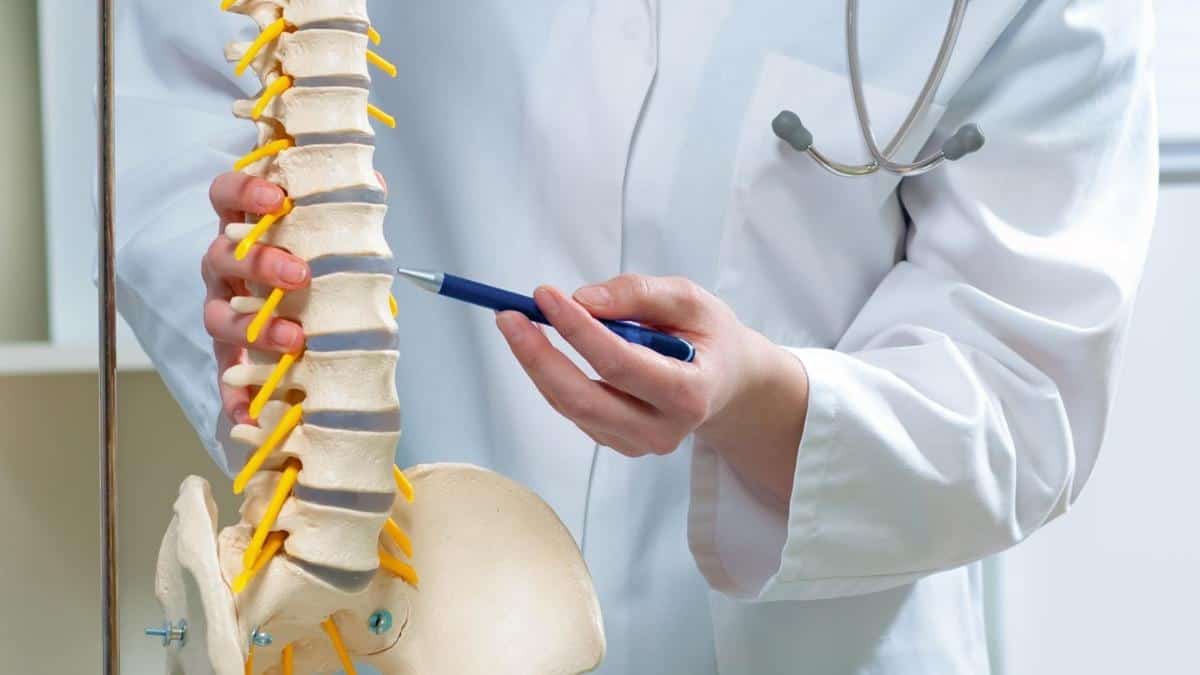
Spinal stenosis refers to narrowing of the spaces within the spine. That narrowing can occur in the central canal, where the spinal cord and nerve roots travel, or in the lateral recesses and neural foramina, where individual nerve roots exit toward the limbs.
Narrowing itself is not the problem. The problem arises when narrowing reduces space enough to compress neural structures or the blood vessels supplying them. This distinction explains something that confuses many patients: significant narrowing can appear on an MRI in someone with no symptoms at all, while another person with less dramatic imaging findings may be substantially limited.
As discs lose height and hydration with age, the vertebrae move closer together. This reduces foraminal height and shifts load onto the facet joints behind.
The facet joints at the back of each spinal segment develop arthritis under increased load. As they enlarge and form bone spurs, they encroach on the canal and the nerve root openings.
The ligamentum flavum runs along the back of the spinal canal. With degeneration it thickens and can buckle inward, which is a frequently underappreciated contributor to central canal narrowing.
Disc material extending backward into the canal or foramen adds to the narrowing, sometimes acutely on top of chronic degenerative change.
When one vertebra slips forward relative to the one below, the canal is effectively narrowed at that level. Degenerative spondylolisthesis at L4-L5 is a common finding alongside stenosis.
Lumbar stenosis characteristically produces neurogenic claudication:
The forward-flexed positions that relieve symptoms do so because flexion slightly increases the available space in the canal. This pattern is one of the more useful clinical clues in distinguishing neurogenic claudication from vascular claudication, which does not improve with position change in the same way.
In the neck, stenosis may produce neck pain, arm pain, numbness, or weakness. When the spinal cord itself is compressed, patients may notice changes in hand dexterity, difficulty with fine motor tasks such as buttons, or changes in balance and gait. These findings warrant prompt evaluation.
New or progressive weakness, loss of bowel or bladder control, numbness in the groin or inner thighs, or a sudden change in gait or coordination require urgent medical evaluation. Do not wait for a scheduled appointment.
Diagnosis rests on the correlation between your symptoms, your physical examination, and your imaging. MRI is the primary imaging study, with CT used in some circumstances. X-rays taken in flexion and extension may be helpful when instability is suspected.
The critical step is correlation. Because degenerative narrowing is common in adults over sixty, imaging alone cannot tell you whether the narrowing seen on the scan is the source of your symptoms. Dr. Goswami’s background in diagnostic and interventional radiology is directly applicable here: images are reviewed personally against the clinical picture rather than accepted from a report.
A substantial number of patients with spinal stenosis are managed without surgery, and conservative care should be given a genuine trial.
Flexion-based exercise programs, core and hip strengthening, and aerobic conditioning that patients can tolerate, such as stationary cycling, form the foundation. Therapy aimed at improving hip mobility can also reduce compensatory extension through the lumbar spine.
Anti-inflammatory medications may reduce symptoms for some patients. Epidural steroid injections are widely used and may provide temporary relief that helps patients participate in therapy, though the duration of benefit varies considerably.
For selected patients, regenerative therapies may be considered as part of an individualized plan. It is important to be clear about what these treatments can and cannot address. Regenerative therapy does not remove bone spurs and does not reverse structural narrowing caused by bony overgrowth.
Where it may have a role is in addressing contributing soft tissue and joint factors, including facet joint arthritis, disc degeneration, and associated inflammation, in patients whose stenosis is not primarily bony. Platelet-rich plasma and stem cell therapy are both studied in this context. Research continues to evolve, outcomes vary between individuals, and these therapies are not appropriate for every patient with stenosis.
Accuracy is more consequential in the spine than almost anywhere else in the body. Dr. Goswami delivers spinal treatments under real-time imaging, targeting specific structures such as facet joints, discs, and the regions around nerve roots, with placement confirmed before delivery. This approach distinguishes his practice from providers who perform non-guided injections.
We will tell you plainly when we believe surgery is the appropriate recommendation. Progressive neurological deficit, significant weakness, symptoms of cord compression in the cervical spine, and bowel or bladder dysfunction are surgical concerns, not candidates for a trial of conservative therapy.
Equally, patients with severe bony central canal stenosis and a walking tolerance measured in a few dozen yards may be better served by decompression surgery than by any regenerative approach. Honest counsel about that is part of the evaluation. Patients who need a spine surgeon are told so.
Start with a free phone consultation with a patient care coordinator. If appropriate, a full evaluation with Dr. Goswami follows, including examination and personal review of your imaging. Procedures are performed on an outpatient basis under image guidance, and most patients return home the same day. Follow-up and ongoing guidance are part of the plan.
The Goswami Clinic operates as a cash-pay practice. We do not accept insurance and we do not accept Medicare. We say so early so patients can decide whether our practice fits their situation before investing further time.
Dr. Gaurav Goswami founded The Goswami Clinic in Newport Beach in 2009. He is triple board certified in Surgery, Interventional Radiology, and Regenerative Medicine, with more than 23 years of post-fellowship clinical experience and over 15 years dedicated to regenerative medicine. He is the author of The Stem Cell Cure, holds a United States medical device patent, and serves as a Scientific Advisor to the American Society of Regenerative Medicine. Both Dr. Goswami and The Goswami Clinic are certified by the American Board of Regenerative Medicine.
The clinic is located at 4425 Jamboree Road, Suite 120, Newport Beach, California, serving patients throughout Orange County including Irvine, Costa Mesa, Huntington Beach, Laguna Beach, and Corona del Mar, as well as patients traveling from across the United States.
Yes, many patients are managed without surgery. Physical therapy, activity modification, medication, and injections help a substantial number of people. Surgery becomes the clearer recommendation when there is progressive neurological deficit or when symptoms severely limit function despite conservative care.
Leaning forward on a cart slightly increases the space available in the spinal canal, which reduces pressure on the nerves. This position-dependent pattern is characteristic of neurogenic claudication from lumbar stenosis.
No. Regenerative therapy does not remove bone spurs or reverse structural narrowing caused by bony overgrowth. It may be considered for contributing soft tissue and joint factors such as facet arthritis and disc degeneration in selected patients. Results vary and it is not appropriate for everyone.
Degenerative stenosis is generally progressive, but the rate varies widely and symptoms do not always worsen in a straight line. Many patients remain stable for long periods with appropriate management.
A herniated disc is displaced disc material that may compress a nerve, often producing symptoms in a single nerve distribution. Stenosis is narrowing of the canal or nerve openings, usually from cumulative degenerative change, and more often produces symptoms with standing and walking. The two frequently coexist.
No. The Goswami Clinic is a cash-pay practice and does not accept insurance or Medicare.
If your walking tolerance has been shrinking and you want to understand your non-surgical options, or you want a second opinion before proceeding with decompression surgery, start with a free phone consultation with a patient care coordinator.
THIS NOTICE MUST BE PROVIDED TO YOU UNDER CALIFORNIA LAW. This physician performs one or more stem cell therapies that have not yet been approved by the United States Food and Drug Administration. You are encouraged to consult with your primary care provider before undergoing any stem cell therapy.