

Advanced Regenerative Medicine
Advanced Regenerative Medicine
- The Goswami Clinic
What Makes a Regenerative Medicine Doctor Qualified?
Medically reviewed by Dr. Gaurav Goswami, MD — prepared October 2026
Regenerative medicine is not one of the specialties certified by the 24 member boards of the American Board of Medical Specialties, so a “regenerative medicine doctor” can come from many different backgrounds. The most meaningful qualifications are board certification from an ABMS member board in a relevant field, hands-on training in image-guided procedures, strong musculoskeletal diagnostic skills, and a practice that treats conditions within the scope of that training.
Contact Us
Why Does a Physician’s Specialty Training Matter?
Because regenerative medicine draws practitioners from so many fields, training varies widely. A study published in JAMA examined 608 clinicians working at U.S. businesses that marketed unproven stem cell procedures; about two-thirds were physicians. Among practices focused on orthopedic conditions, 77% had at least one physician with specialty training appropriate to those conditions. Among companies marketing stem cells for non-orthopedic conditions, however, only 19% had physicians practicing within their scope of training.
A separate study of stem cell businesses in the Southwest found that their care providers were certified by more than 30 different medical boards, which the authors read as a sign of little consistency in training and oversight. The takeaway for patients is simple: ask what your physician trained in, and whether your condition falls within that training.
Contact Us
Which Medical Backgrounds Are Most Relevant?
For joint, tendon, and spine conditions, the most relevant backgrounds combine musculoskeletal diagnosis with procedural skill. Examples include orthopedic surgery, physical medicine and rehabilitation, sports medicine, pain medicine, and interventional radiology, the specialty built around using imaging to guide needles and instruments precisely to a target inside the body.
No single specialty owns the field, and capable physicians come from each of these backgrounds. What matters is that the training lines up with the condition being treated, whether that’s joint pain or a spine condition, and that the physician performs the procedure regularly.
Why Does Diagnostic Skill Matter as Much as Procedural Skill?
The best injection technique won’t help if the diagnosis is wrong. Pain around a joint can come from the joint surface, nearby tendons, nerves, or a more distant source such as the spine. A qualified physician invests time in the exam and the imaging review, and is willing to recommend a different treatment, or a different specialist, when the findings point elsewhere. That diagnostic discipline is also what protects patients from paying for treatments that are unlikely to help them.
Why Is Image Guidance a Core Skill?
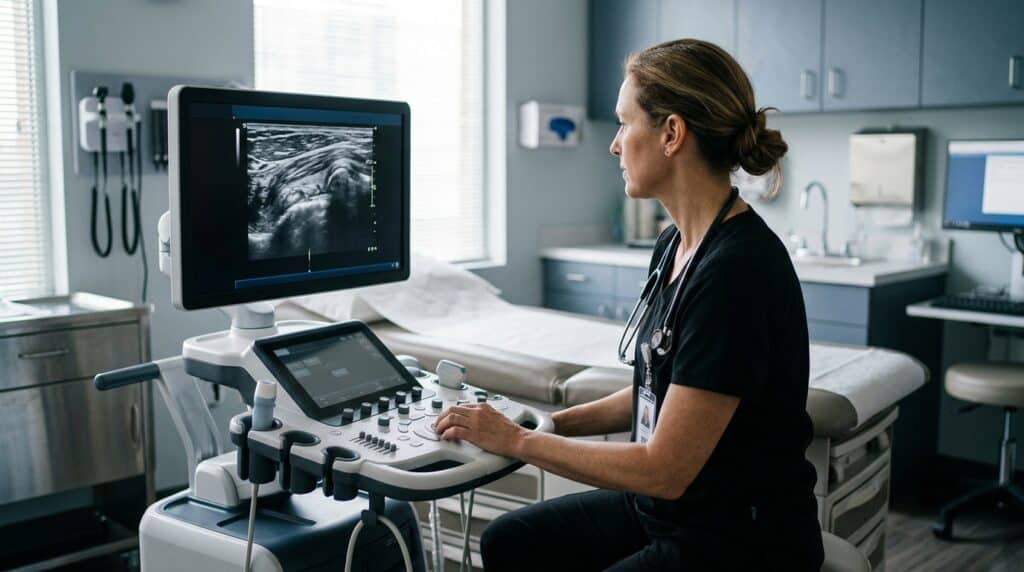
Placement matters, because a treatment can only work if it reaches the intended tissue. An umbrella review of systematic reviews found that ultrasound-guided injections were generally more accurate than injections placed by anatomical landmarks alone, particularly in the shoulder, although results for pain relief and function varied between studies.
For osteoarthritis specifically, a 2024 meta-analysis of randomized trials found that ultrasound-guided joint injections produced better clinical outcomes than landmark-guided injections in the knee, hip, and hand. The same review notes that ultrasound allows real-time visualization of nearby blood vessels and nerves without radiation exposure. Deeper targets such as the hip and spine are often treated under fluoroscopy, a form of live X-ray. A physician trained in these techniques is better equipped to place treatment accurately.

What Should Happen at Your First Visit?
A qualified regenerative medicine physician will usually:
- Take a detailed history of your symptoms, prior treatments, and goals.
- Perform a hands-on examination and review or order imaging such as X-ray, MRI, or ultrasound.
- Explain your diagnosis and the full range of options, including non-regenerative ones.
- Discuss the evidence for any recommended treatment, its FDA status, and realistic expectations.
- Tell you plainly if you are not a good candidate.
- Provide a written estimate before scheduling.
If a consultation skips these steps, it’s reasonable to slow down and seek a second opinion before committing to treatment.
What Questions Should You Ask a Regenerative Medicine Doctor?
Bring these questions to any consultation, and pay attention to how directly they’re answered:
- Which board certified you, and in what specialty?
- How often do you perform this procedure, and do you perform it yourself?
- Will imaging be used to guide the injection?
- What is the source of the cells, and how are they processed?
- What does the published evidence show for my specific condition?
- What are the risks, and what would make me a poor candidate?
We’ve compiled more in our guide to questions to ask when considering stem cell therapy.
What Is Dr. Goswami’s Training and Background?
Dr. Gaurav Goswami is board-certified by the American Board of Radiology in diagnostic and interventional radiology and is a diplomate of the American Board of Regenerative Medicine. He completed his surgical residency at Grant Medical College (University of Bombay), where he served as chief resident, and later completed a fellowship in vascular and interventional radiology through the George Washington University School of Medicine and Health Sciences.
He founded The Goswami Clinic in Newport Beach in 2009, serves as a clinical assistant professor at Western University of Health Sciences and as a scientific advisor to the American Society of Regenerative Medicine, and is the co-author of The Stem Cell Cure. He also teaches other physicians through our regenerative medicine training course. You can read his full background on our About page.
Frequently Asked Questions
What kind of doctor performs stem cell injections?
Stem cell injections are performed by physicians from several specialties, including orthopedic surgery, physical medicine and rehabilitation, sports medicine, pain medicine, and interventional radiology. The most important factors are relevant board certification, image-guided procedural training, and experience with your specific condition.
Is a regenerative medicine certification the same as board certification?
No. Regenerative medicine certifications are offered by private organizations separate from the 24 member boards of the American Board of Medical Specialties. They can reflect added training, but they are not ABMS specialty board certification.
Should a regenerative medicine doctor use ultrasound or fluoroscopy?
In most cases, image guidance is preferable. Research shows ultrasound-guided injections are generally more accurate than landmark-guided injections, and deeper targets such as the hip and spine are often treated under fluoroscopy.
How can I verify a doctor's board certification?
You can look up a physician’s certification through the American Board of Medical Specialties’ Certification Matters service and confirm licensure through the Medical Board of California’s online license lookup.
Should a regenerative medicine doctor review my MRI?
Usually, yes. Imaging such as MRI, X-ray, or diagnostic ultrasound helps confirm the diagnosis, grade any arthritis, and plan where treatment should be placed. If imaging is outdated or missing, a careful physician may order new studies before recommending treatment.
Is it a red flag if a doctor treats many unrelated conditions with stem cells?
It can be. A JAMA study found that clinicians at stem cell businesses often treated conditions outside their scope of training, especially for non-orthopedic uses. A physician whose practice matches their training is generally the safer choice.
Want to talk with a physician about your condition? Schedule a free phone consultation with our team.