

Advanced Regenerative Medicine
Advanced Regenerative Medicine
- The Goswami Clinic
Regenerative Medicine Near Newport Beach, CA
Medically reviewed by Dr. Gaurav Goswami, MD — prepared September 2026
If you’re searching for regenerative medicine near Newport Beach, the fastest way to narrow your options is to check three things: the treating physician’s board certifications, whether the practice uses image guidance for injections, and how clearly they disclose which treatments are FDA-approved versus investigational. A short phone call before you book anything is usually enough to answer all three.
Contact Us
What Is Regenerative Medicine?
Regenerative medicine is an umbrella term for treatments that try to help the body repair or replace damaged tissue rather than simply managing symptoms with medication. In an orthopedic or sports-medicine setting, that usually means stem cell therapy, platelet-rich plasma (PRP) therapy, or a combination of the two, used to address joint pain, tendon and ligament injuries, or certain spine conditions.
Unlike a prescription or a surgical implant, these treatments generally use material drawn from your own body — blood, bone marrow, or fat tissue — which is processed and then reintroduced into the area that needs support. Because the approach is biologic rather than purely pharmaceutical or mechanical, many patients first hear about it from a friend’s experience, a podcast, or a search online rather than a referral from their primary care doctor. That word-of-mouth path is part of why knowing what to look for in a provider matters so much.
Contact Us
Why Are So Many Patients in Orange County Searching for This?
Newport Beach and the surrounding Orange County area have an unusually active, health-conscious population, and a large number of residents are looking for ways to stay mobile without surgery — whether that’s a longtime tennis player managing a shoulder issue, a runner dealing with knee pain, or someone simply trying to delay a joint replacement for as long as reasonably possible. Regenerative medicine has become a popular search term partly because it sits between “do nothing and hope it improves” and “have surgery,” and a lot of people want to understand that middle ground before committing to either end.
That demand is also why the number of clinics using the phrase “regenerative medicine” has grown quickly across Southern California, which makes it harder — not easier — to tell providers apart from the outside. A clinic’s website can list an impressive-sounding menu of services without that menu necessarily reflecting the physician’s actual training or hands-on experience with each one.
What Credentials Should a Regenerative Medicine Doctor Have?
Because regenerative medicine sits at the intersection of several specialties, the credentials that matter most are board certification in a relevant field — such as surgery, interventional radiology, or regenerative medicine itself — along with specific, verifiable training in cell-based procedures. Board certification means a physician has completed a recognized residency and passed a rigorous specialty examination; it is not the same thing as having attended a weekend course on injections.
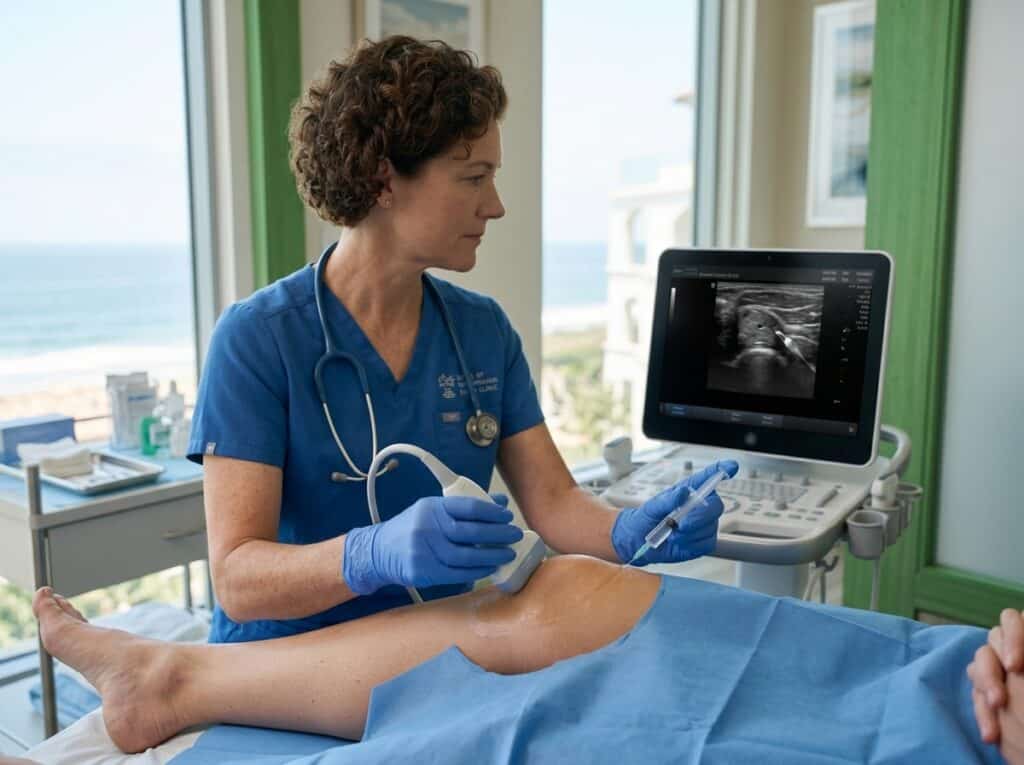
Care at The Goswami Clinic is led by a physician board-certified in Surgery and Interventional Radiology, with additional specialty training and certification in regenerative medicine — the kind of layered background worth asking about wherever you’re considering care. Interventional radiology training, in particular, is directly relevant here, since it’s the specialty most focused on using ultrasound and fluoroscopy to place instruments precisely inside the body, which is exactly the skill involved in an image-guided joint or spine injection.
What Questions Should You Ask Before Choosing a Provider?
A short list of questions can tell you a lot in a single phone call, before you ever schedule an in-person visit:
Are the cells or platelets used my own (autologous), or do they come from a donor source?
Is imaging — ultrasound or fluoroscopy — used to guide the injection, or is it placed by feel?
Which of the treatments offered are FDA-approved, and which are considered investigational?
What is the physician's specific experience with my condition, not just with regenerative medicine broadly?
How is pricing structured, since most regenerative treatments are cash-pay rather than billed to insurance?
Does the practice require an in-person evaluation and imaging before recommending a treatment plan?
What Conditions Does Regenerative Medicine Typically Address?
Most of the demand for regenerative medicine in this market centers on a fairly consistent set of conditions: joint pain and osteoarthritis, particularly in the knee and hip; tendon and ligament injuries, including shoulder and rotator cuff issues; and select spine conditions such as disc-related pain.
Osteoarthritis in particular is a degenerative joint disease in which the tissues in the joint break down over time, as the National Institute of Arthritis and Musculoskeletal and Skin Diseases (NIAMS) explains in its patient overview — which is why treatments aimed at supporting tissue, rather than only masking pain, draw so much interest.
The specific approach — stem cell therapy, PRP, or a combination — usually depends on the condition, its severity, and imaging findings, which is why an accurate diagnosis has to come before any real discussion of treatment. You can see the fuller range of conditions addressed at The Goswami Clinic on our Conditions We Treat page.
What Else Is Worth Knowing About a Practice?
Beyond credentials, it’s worth asking whether a practice treats regenerative medicine as a primary focus rather than an add-on service. A physician who also trains other physicians in these techniques is generally treating the field as a core discipline rather than a side offering — training other doctors requires a depth of experience that a part-time practitioner typically hasn’t built up.
Transparency about regulatory status is equally important. The FDA’s consumer alert on regenerative medicine products makes clear that most stem cell and exosome products marketed for orthopedic conditions have not received FDA approval, and encourages patients to ask direct questions before proceeding. A provider who volunteers that information rather than avoiding it is demonstrating exactly the kind of candor worth looking for.
Published clinical work, patents, or leadership roles within professional societies are the kinds of signals that are harder to manufacture than a polished website, and they’re entirely reasonable things to ask a prospective provider about directly during a consultation.
How Does Online Research Differ From an In-Person Evaluation?
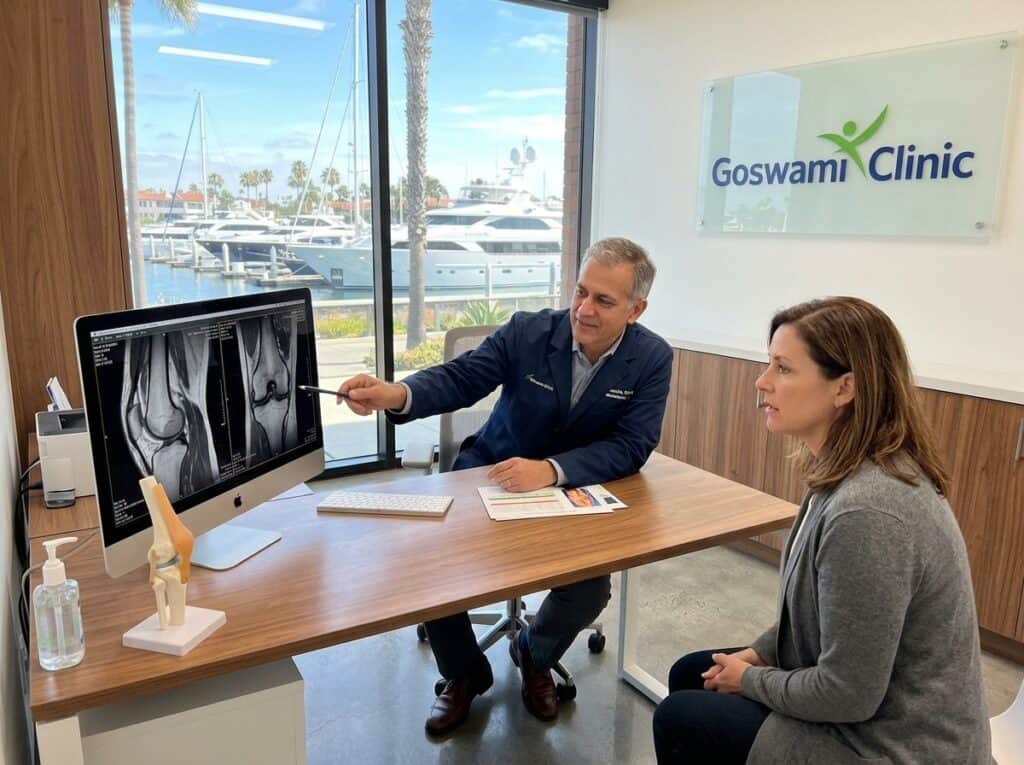
It’s worth setting expectations here: no amount of reading online — including this article — can substitute for an individualized, in-person evaluation. Search results and blog posts can help you understand the landscape and prepare better questions, but a physician needs to examine you, review your imaging, and understand your specific history before recommending anything. A free phone consultation is usually a low-friction way to get that individualized read on your situation before committing to an in-person visit.
Frequently Asked Questions
Is regenerative medicine covered by insurance?
Most regenerative treatments, including stem cell therapy and PRP, are considered elective procedures and are typically offered on a cash-pay basis rather than billed to insurance. Ask any practice you’re considering for a clear breakdown of costs before scheduling.
What conditions do regenerative medicine practices typically treat?
Common applications include joint pain and osteoarthritis, tendon and ligament injuries, and select spine conditions. You can see the full range of conditions addressed at The Goswami Clinic on our Conditions We Treat page.
Is regenerative medicine safe?
Safety depends heavily on the specific treatment, the source of the cells or platelets used, and the physician’s training. You’re encouraged to consult with your primary care physician before undergoing any stem cell therapy — see the disclosure above — and to ask your provider directly about safety considerations for your specific condition.
How is regenerative medicine different from physical therapy or a cortisone shot?
Physical therapy focuses on strengthening and mobility, and a cortisone injection reduces inflammation quickly but temporarily, without directly addressing the underlying tissue. Regenerative approaches are intended to support the body’s own repair process instead, and are often used alongside — rather than strictly instead of — conservative care like physical therapy. Which combination makes sense depends on your specific condition.
How soon can I be seen for an evaluation?
Scheduling varies by practice and time of year. The most efficient first step is usually a free phone consultation, which can help clarify next steps and typical wait times for an in-person evaluation.
If you’d like to discuss whether regenerative medicine is a fit for your condition, schedule a free phone consultation with our team.